1) Portrait understanding
Painting or drawing
or shooting with a camera doesn't change the essence of the meaning
“portrait”. A portrait is created to tell the story, the
attitude or to stop in a eternal moment a feeling of the sitter.
One
of the most important things about portrait photography is an interest
in our subjects or humanity in general.

The
subject that we are going to draw with our camera needs our
attention, our focus, our full understanding to better appear on our
lighted description of him/her. When
we look at portraits, we learn
about the people in them, more often there is just one person but we
can have portraits of families, groups or historical representatives
of social groups, classes or events.
We
all reveal our feelings and attitudes differently. Some of us may
show our individual character with immediate transparency, while
others may be more difficult to “read” at first. The photographer
must become proficient at studying people whom he or she doesn’t
know in order to capture their essence. This means watching for
signals in a subject’s mannerism,
reactions, expressions,
body language and
so on, and then judging how best to have the subject’s character
revealed for the camera.
This
requires passion and an understanding of human nature. It is almost
always better engaging the subject in conversation, and quickly
finding a suitable topic that will grab her or his interest and evoke
a reaction. Find common ground or a topic of particular interest to
your subject, which can be a hobby, the latest news, a mutual
acquaintance, or any number of topics. Building a rapport with the
subject is important, whether a three-year-old child or a
ninety-five-year old statesman, because it makes the subject more at
ease in your presence, and therefore more-relaxed and natural-looking
for the lens.
We must take all possible steps to put a subject at ease in order for
her or him to appear natural.
2) In studio or in location
There
are two elements to a photo studio for portrait photography. One is a
controlled background. We want to focus attention on our subject and
avoid distracting elements in the frame. Probably the best portraits
are not taken against a grey seamless paper roll but in the natural
subject location, in a city market, on a river, inside their own
house or on the streets. On the other hand, we are unlikely to screw
up and leave something distracting in the frame if we confine ourselves to using seamless paper or other monochromatic backgrounds. We don't
have to build a special room to have a controlled background. Usually
a monochromatic wall it is enough. If we absolutely cannot control
the background, the standard way to cheat is to use a long lens,
e.g., 300/2.8. Fast telephoto lenses have very little depth of field.
Our subject's eyes and nose will be sharp. Everything else that might
have been distracting will be blurred into blobs of colour.

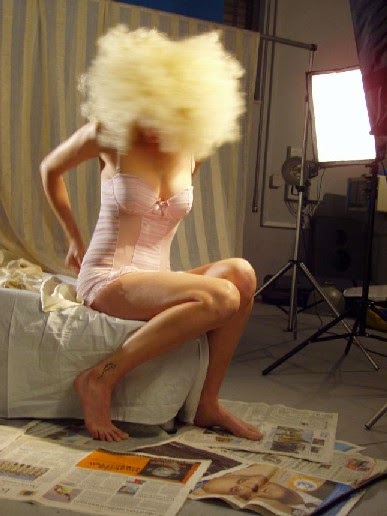
We
can notice that both pictures are taken in a photo studio but the
first from the left
is
concerning about the pose and the lighting, the second one, instead, it is focusing on showing the set behind and emotions behind the photo.
What
if we don't have a big open space with diffuse light and a neutral
background? We can find one. Everywhere we live, in every city or
village, there is a vast open space with natural light or artificial
lights like a train station a shopping mall a museum, a mountain or a
beach . With any lens set to f/2.8 or f/3.5, the background will be
thrown out of focus. Here are some examples from city shooting:
 |
The background is not blur but doesn't steal the focus from the subject. |
 |
The overexposure and the image composition
are driving the viewer to the subject face following a virtual line |
 |
| In this image we show the location but we leave it blur to keep the focus on the subject. |
3) Composition, point
of view and prospective
Most
portraits are taken with the camera at (or around) the eye level of
the subject. While this is good common sense – completely changing
the angle that you shoot from can give your portrait a real WOW
factor.
We
can get up high and shoot down on our subject or get as close to the
ground as we can and shoot up. Either way we’ll be seeing our
subject from an angle that is bound to create interest.

It is amazing how much the direction
of our subject’s eyes can impact an image. Most portraits have the
subject looking in the lens – something that can create a real
sense of connection between a subject and those viewing the image but
there are a couple of other things that we can try:
A)
The off camera looking, have our subject focus their attention on
something unseen and outside the field of view of your camera. This
can create a feeling of candidness and also create a little intrigue
and interest as the viewer of the shot wonders what they are looking
at. This intrigue is particularly drawn about when the subject is
showing some kind of emotion (for example ‘what’s making them
laugh?’ or ‘what is making them look surprised?’). We must be
aware that when we have a subject looking out of frame that we can
also draw the eye of the viewer of the shot to the edge of the image
also (taking them away from the point of interest in our shot) the
subject.
 |
| Eye contact can be important but we can try other solutions, as this image shows |
B) Looks within the frame,
alternatively you could have your subject looking at something (or
someone) within the frame. A child looking at a ball, a woman looking
at her new baby, a man looking hungrily at a big plate of pasta….
When you give your subject something to look at that is inside the
frame you create a second point of interest and a relationship
between it and your primary subject. It also helps create ’story’
within the image.


